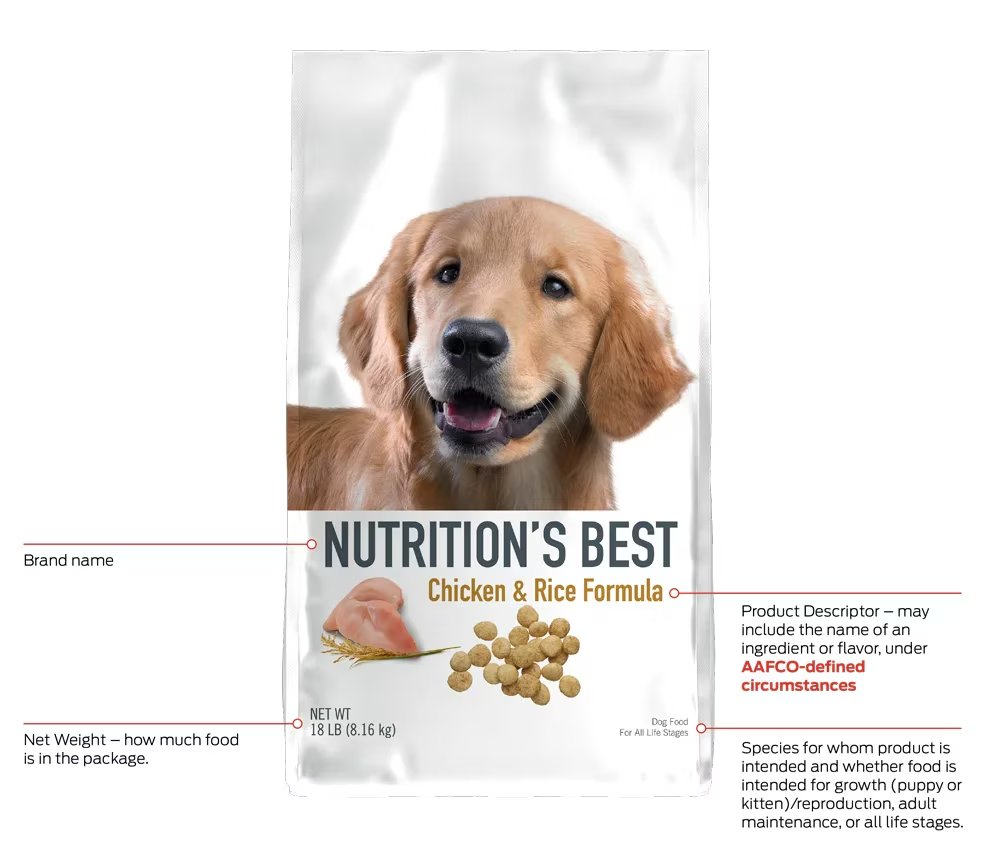
"Complete and balanced." You see it on every bag. It sounds official. It sounds scientific. It sounds like someone in a lab coat signed off on it.
And it's true — technically. But here's what it doesn't tell you.
AAFCO — the Association of American Feed Control Officials — sets nutrient profiles for dog food. If a food meets those minimum and maximum levels for protein, fat, vitamins, and minerals, it can say "complete and balanced." That's good. It means your dog won't get scurvy or rickets. Seriously. That's the bar.
But it doesn't tell you about calorie density. It doesn't tell you about ingredient quality — whether that "chicken" is whole chicken meat or chicken feathers ground up. (Yes, that happens. No, I'm not joking.) It doesn't tell you if that food will make your dog fat.
I had a client whose dog was on a "premium" kibble labeled complete and balanced. The food came in a fancy bag with a wolf on it. The dog was morbidly obese — BCS of 8, could barely walk. When we calculated the calories, that kibble had 480 calories per cup. Almost 100 more than a standard kibble. The owner had been feeding the same volume as before — two cups a day — but the calorie density was 25 percent higher. The dog was eating like he was getting an extra meal every day.
The label didn't lie. But it didn't warn either.
Here's what "complete and balanced" actually means: the food won't kill your dog through nutrient deficiency. That's it. It doesn't mean the food is good. It doesn't mean the food is appropriate for your dog's age, size, or activity level. It doesn't mean the food won't make your dog fat. It just means it meets minimum nutrient requirements.
I tell my clients to ignore the front of the bag. The wolf, the mountain, the "natural" label — it's all marketing. Turn the bag over. Look at the guaranteed analysis. Look at the calorie content per cup. Look at the ingredient list. The first five ingredients tell you 90 percent of what you need to know. If the first ingredient is a specific meat — "chicken," "beef," "salmon" — that's good. If it's "meat by-products" or "poultry meal," that's less good. If the first ingredient is corn or wheat, that's a red flag for most dogs.
And always, always check the calorie content. Because "complete and balanced" doesn't mean "low calorie." And your dog doesn't care about the label. They care about the food. And their waistline.
—Megan (currently on my third cup of coffee because writing this made me tired)
Let me tell you about the worst dog food I ever saw. It was a "premium" brand. Fancy bag. Beautiful photography. A wolf running through a forest. The label said "complete and balanced." The first ingredient was "chicken." Sounds good, right?
I looked closer. The "chicken" was chicken by-product meal. Not chicken meat. Chicken by-products. That means feet, heads, feathers, and organs. Ground up. Processed. Dried. It's not illegal. It's not even bad, nutritionally. But it's not what most people think they're buying when they see "chicken" on the label.
The second ingredient was corn. The third was wheat. The fourth was corn gluten meal. The fifth was chicken fat. So the first five ingredients were: chicken by-products, corn, wheat, corn gluten, and fat. That's not a premium food. That's a grain-based food with some chicken flavoring.
And the calorie density? 520 calories per cup. For a food marketed to "active" dogs. Active dogs don't need 520 calories per cup. Working dogs might. But your couch potato Lab? Your apartment-dwelling Frenchie? They need 350-400 calories per cup. This food was making dogs fat while claiming to be "complete and balanced."
I had a client named David. He bought this food because of the wolf on the bag. His Lab, Cooper, gained 15 pounds in a year. David was baffled. "I feed him the recommended amount," he said. "And it's complete and balanced." I showed him the calorie content. I showed him the ingredients. I showed him that "complete and balanced" doesn't mean "appropriate for your dog." David switched foods. Cooper lost the weight. And David became the most skeptical dog food shopper I've ever met.
So here's what I tell every client. Ignore the front of the bag. The pictures, the claims, the certifications — they're all marketing. Turn the bag over. Read the guaranteed analysis. Check the calorie content. Look at the first five ingredients. And remember: "complete and balanced" just means "won't cause nutrient deficiency." It doesn't mean "good." It doesn't mean "appropriate." It doesn't mean "low calorie." It just means the minimum. And your dog deserves more than the minimum.
—Megan (currently on my third cup of coffee because writing this made me tired)
Let me tell you about the client who taught me the most about dog food labels. His name was Richard. He was a lawyer. Very analytical. Very detail-oriented. He came to me with a spreadsheet. He had analyzed 47 different dog foods. He had compared protein percentages. Fat percentages. Fiber percentages. Price per pound. He had charts. Graphs. Pivot tables.
And he was feeding his 50-pound Lab, Duke, a food that was making him fat. Because Richard had missed the one thing that mattered most: calorie density.
The food Richard chose had 480 calories per cup. It was "high protein." It was "grain-free." It was "complete and balanced." But it was also high calorie. And Richard was feeding Duke 3 cups per day because "that's what the bag says for a 50-pound dog."
Three cups at 480 calories? 1,440 calories. Duke needed 900. Richard was overfeeding by 60 percent. And Duke was 15 pounds overweight. Not because Richard was careless. Because Richard was looking at the wrong numbers.
I showed Richard the calorie content. I showed him Duke's ideal weight. I showed him the math. He was stunned. "I spent 20 hours researching dog food," he said. "And I missed the most important thing."
We switched Duke to a food with 350 calories per cup. Same volume. Same feeding schedule. Duke lost 12 pounds in 8 months. Richard became a calorie evangelist. He tells everyone: "Ignore the front of the bag. Turn it over. Find the calories per cup. That's the only number that matters for weight."
And he's right. The front of the bag is marketing. The wolf, the mountain, the "natural" label — it's all designed to make you feel good about your choice. But the back of the bag is where the truth lives. The guaranteed analysis. The calorie content. The ingredient list. That's where you find out if the food is actually good for your dog. Or if it's just good at marketing.
So turn the bag over. Read the back. Ignore the front. Because "complete and balanced" doesn't mean "good for your dog." It just means "won't kill them through deficiency." And your dog deserves more than "won't kill them." Your dog deserves "will help them thrive." And that starts with you reading the label. Really reading it. Not just the front. The back. Where the truth is.
—Megan (currently on my third cup of coffee because writing this made me tired)