I was at The Filling Station last week — that's the pet supply store on Division, the one with the free nutritional counseling. I wasn't working. I was just buying dog food. But I overheard a guy talking to the cashier about his dog's weight. "He's just a little chunky," the guy said. "The vet says he's fine."
I looked over. The guy had a Lab. A big one. Maybe 90 pounds. And I could see, from across the store, that this dog had no waist. None. His body went from ribs to hips in a straight line. Like a sausage. Like a furry tube. Like a dog-shaped cylinder.
I wanted to say something. I didn't. It's not my store. I'm not working. But I wanted to hand him a BCS chart. I wanted to show him what a healthy dog looks like. I wanted to tell him that "a little chunky" is not fine. That "a little chunky" is the first step to obesity. That "a little chunky" is a warning sign that most owners ignore until it's too late.
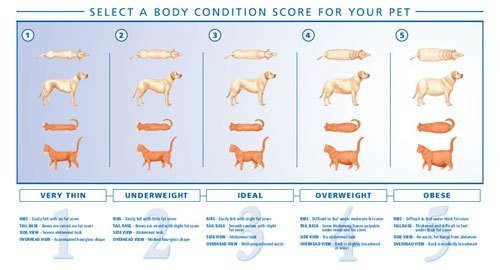
BCS stands for Body Condition Score. It's a 1-9 scale. One is emaciated. Nine is morbidly obese. Five is ideal. And most people have no idea what a 5 looks like. Because they've never seen one. Because every dog at the dog park is a 6 or 7. Because "a little chunky" is the new normal.
A dog at a healthy BCS of 5 has a visible waist. You can see it from above. The body narrows behind the ribs. Like an hourglass. Like a dog. Not like a tube. Not like a sausage. Like a dog. You can also feel the ribs. Not see them. Feel them. With gentle pressure. Like the back of your hand. Not like your knuckles. Not like your palm. Like the back of your hand. Slight padding. But present. There. Real.
I learned about BCS in vet school. I thought I understood it. I didn't. Not really. Not until I started using it every day. Not until I started scoring every dog I saw. Not until I realized that most dogs — most dogs — are a 6 or 7. And most owners think they're a 5. Because they don't know what a 5 looks like. Because they've never seen one. Because the dog park is full of 6s and 7s. And the 5s look "too thin."
I had a client named Jennifer. She brought in her 50-pound Lab, Cooper. Cooper was a 7. Maybe an 8. His waist was gone. His ribs were buried. He waddled when he walked. Jennifer thought he was a 5. "The vet never said anything," she told me. "He just said Cooper was 'a little heavy.'"
A little heavy. That's what vets say when they don't want to offend. When they don't want to lose a client. When they don't want to be the bad guy. So they say "a little heavy." And owners hear "fine." And dogs get fatter. And vets stay in business. And dogs die early. And everyone is polite. And everyone is sad.
I showed Jennifer the BCS chart. I printed it out. I laminated it. I gave it to her. I showed her what a 5 looks like. I showed her what Cooper looked like. I showed her the difference. She stared at the chart. She stared at Cooper. She stared at me. "He's really a 7?" she asked. "He's really overweight?"
"Yes," I said. "And it's not your fault. You didn't know. But now you do. And now we can do something about it."
We put Cooper on a diet. Measured meals. No free feeding. Limited treats. And we started weighing him monthly. Not annually. Monthly. Because weight gain is gradual. And gradual change is invisible. Until it's not. Until the dog is a 7. Or an 8. Or a 9. And then it's hard. And then it's expensive. And then it's heartbreaking.
Cooper lost 10 pounds in 8 months. He went from a 7 to a 5. His waist came back. His ribs became feelable. He started running. He started jumping. He started living. Jennifer called me last month. "I saw another Lab at the park," she said. "He was huge. And his owner said he was 'fine.' I wanted to give her the chart. I wanted to tell her. I wanted to help."
"So do it," I said. "Give her the chart. Tell her. Help her. Because that's how we change things. One chart at a time. One dog at a time. One owner at a time. Because BCS is not just a number. It's a lifeline. And every dog deserves to know what a 5 feels like."
—Megan (currently on my third cup of coffee because writing this made me tired)
Let me tell you about the most transformative moment I've ever had with a client. It was with a woman named Sarah. She had a 70-pound Golden Retriever named Max. Max was 12 pounds overweight. Sarah had been told by three different vets that Max was "fine." "A little heavy." "Could lose a few." But no one had shown her the BCS chart. No one had explained what a 5 looked like. No one had made it real.
I printed out the BCS chart. I laminated it. I gave it to Sarah. I showed her Max from above. I showed her the chart. I showed her the difference. I showed her what a waist looked like. What ribs felt like. What a healthy dog looked like. And Sarah stared. And Sarah cried. Because she realized, in that moment, that Max was not fine. That Max was not "a little heavy." That Max was overweight. Significantly. Dangerously. And she had been told he was fine. By three vets. Who were too polite. Too busy. Too afraid of losing a client. To tell her the truth.
We put Max on a diet. Measured meals. No free feeding. Limited treats. And we started weighing him monthly. Not annually. Monthly. Because weight gain is gradual. And gradual is invisible. Until it's not. Until the dog is 12 pounds overweight. And the joints are failing. And the heart is struggling. And the life is shortening. And then it's too late.
Max lost 10 pounds in 8 months. Sarah called me last week. Max is 10 now. He's running at the park. He's climbing stairs. He's jumping on the bed. He's living. And Sarah carries the BCS chart in her purse. She shows it to other dog owners. She tells them what a 5 looks like. She tells them what "fine" really means. And she saves dogs. One chart at a time. One conversation at a time. One owner at a time.
That's the power of the BCS chart. It's not just a number. It's a language. A language that vets are too afraid to speak. A language that owners need to learn. A language that saves lives. And you can learn it. You can speak it. You can share it. And you can save dogs. Starting with your own. Starting today. Starting with a chart. A simple, laminated, 1-9 chart. That shows you what healthy looks like. And what "fine" really means. And what love really is. Not food. Not treats. Not "just a little bit." Love is health. And health is a 5. And a 5 is beautiful. And your dog deserves to be a 5. And you deserve to see it. And know it. And make it happen. Starting now. Starting today. Starting with a chart.
—Megan (currently on my third cup of coffee because writing this made me tired)